
ING Aether
The First Banking AI Agent in Europe
Product Type
AI Agent
Generative UI
Beta Testing(10,000 Users)
Global Launch 2026 Sep
My Role
End-to-end Design
Prompt Engineering
Front-end Prototyping
Time
3 Major Iterations
1-Month Concept Design
3-Month Tech Validation
1-Month Final Design
With
1 Product Lead
1 Dev Lead
2 AI Engineers
6 Developers

Summary
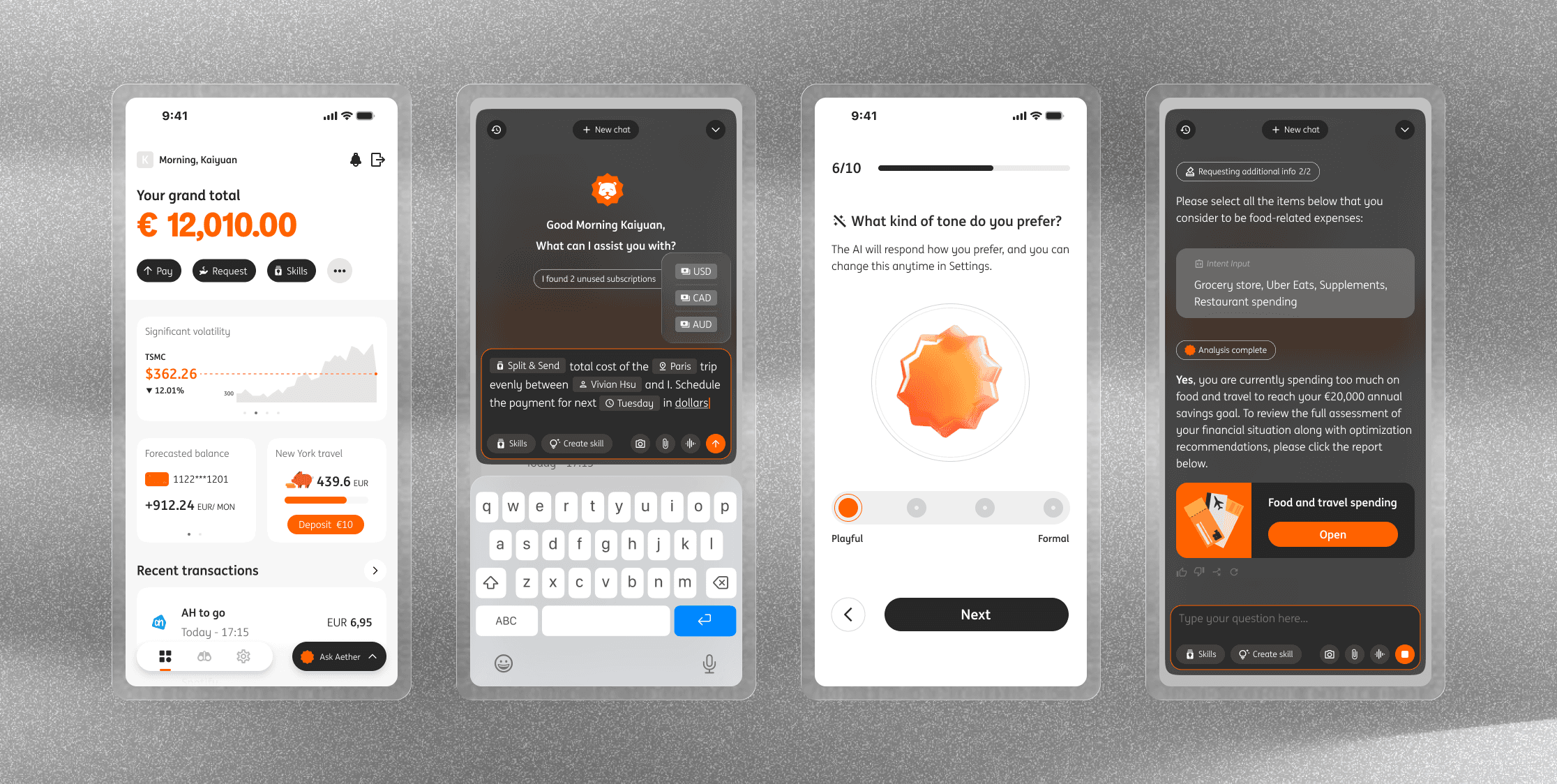
ING Aether received the UX Design Award, the Indigo Design Award, and the European Product Design Award. It is an AI-powered banking app that reimagines banking by offering a seamless, personalized experience. It addresses traditional frustrations like complex navigation and inefficiency through AI Agents and generative UI. Key features include proactive suggestions, real-time feedback, task automation, and Finance education. Home screen widgets can be generated by AI based on user needs. Users can also customize Aether’s tone and data access for personalized, efficient, and emotionally engaging banking.
I led the end-to-end design process, covering UI, component systems, and motion design, while defining Aether’s output formats across different use cases and interaction scenarios. I navigated internal stakeholder resistance within the bank, defended a high standard of design quality, ultimately advancing the project to the beta testing phase.
Comparing Beta testing data with the original ING app, ING Aether achieved a 22% increase in NPS, a 20% increase in CSAT, a 98% Task Success Rate for key user journeys, and a 45% reduction in key task time.
ING Aether will launch as an independent app in multiple EU countries in September 2026.
Background
In early 2024 at ING, I anticipated that AI agents would become the dominant application paradigm and created Aether(PoC), a concept banking AI agent app. Although it wasn’t feasible to launch due to LLM maturity and commercial constraints, it received strong internal recognition at ING. Below is a clip from the PoC video:
In 2025, as neobanks captured ING’s younger audience with more intuitive and personalized experiences, and as AI reshaped the financial industry, ING leadership recognized Aether’s value and decided to commercialize it as Europe’s first banking AI agent.
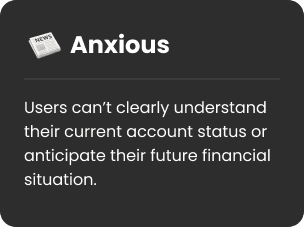
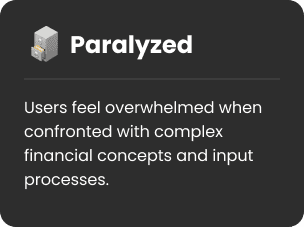
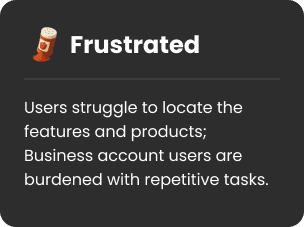
User Problems
Design Goals
This project focused on designing an AI-native banking experience that seamlessly integrates AI to enhance efficiency while keeping the user in control. The goal was to create a system that reduces friction and learning curves, provides proactive assistance, and balances automation with user agency—ensuring users can make informed decisions and trust the AI-generated outcomes.

Design Process Highlights
In the first three months, I collaborated with XFN partners to define a list of potential features. We evaluated the cost, feasibility, and stability of implementing them based on the capabilities of Gemini, while working closely with the legal team to address compliance requirements.
In the following month, I synthesized key user experience issues in the existing app and explored how AI-driven user journeys could address them. Finally, I validated and iterated on the design through vibe coding and user testing.

Contextual Proactivity
Early AI systems, such as Alexa, were passive—they required human input to produce output. Over time, AI evolved into a collaborative form, where humans initiate tasks and AI works alongside them; most current LLMs operate at this stage. In the future, AI should be capable of proactively initiating tasks based on contextual information, requiring only human confirmation—this is what proactive AI represents.
In my redesigned information architecture, the original 5 tabs organized by business type were replaced with 3 tabs designed around mental models. The Home tab allows users to view existing financial products. The Explore tab lets users browse AI-generated financial products. The Settings tab provides access to Aether management and app preferences. Aether is always present in the navigation in the form of a conversational bar. Aether provides different input suggestions in the chat window based on the current page.
Layout
Conversational Bar
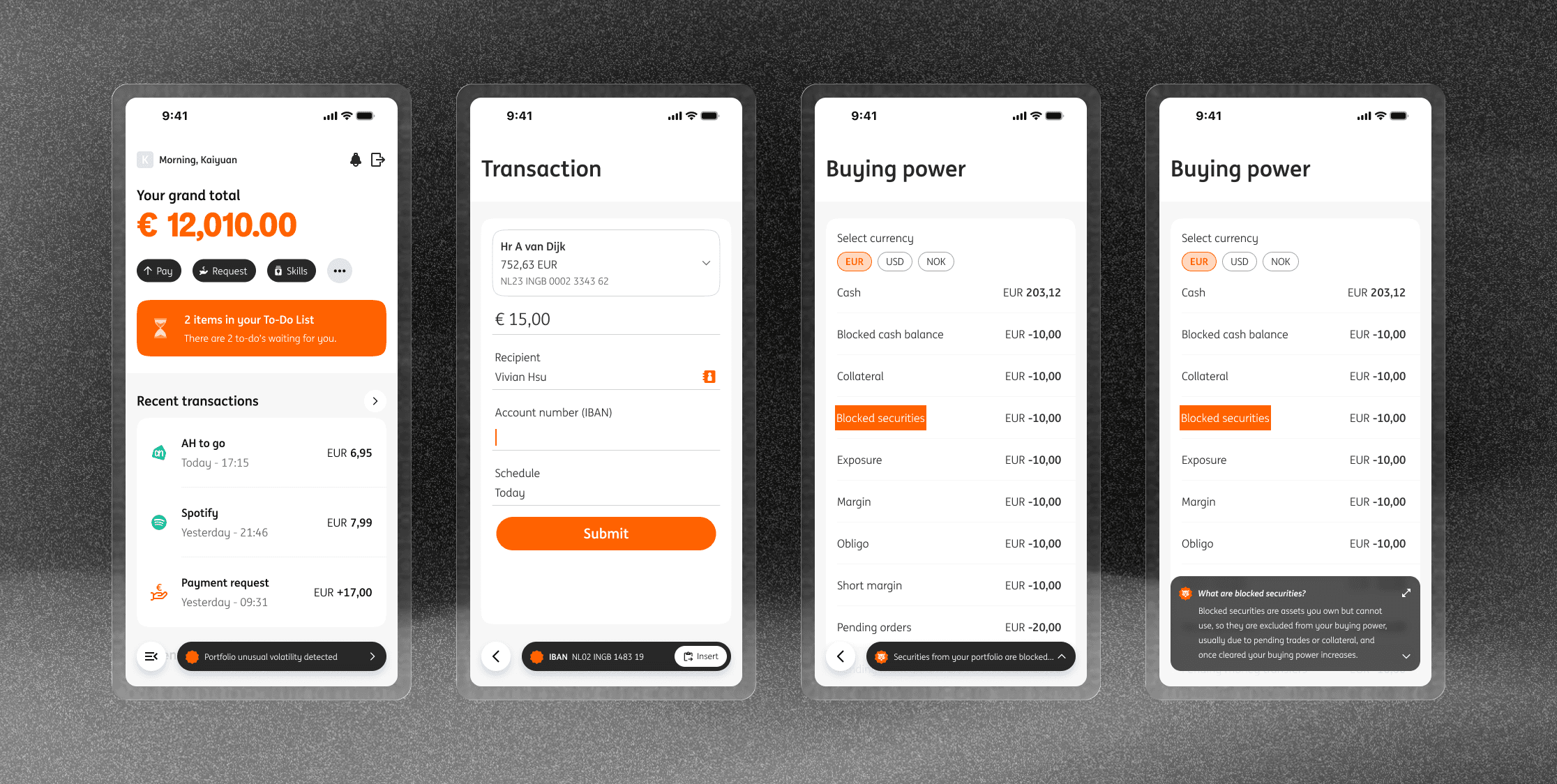
The conversational bar is a new AI UX pattern I invented. It provides contextual AI assistance based on the current page and user actions without requiring the chat window to be opened. For example, when entering an IBAN, the conversational bar can suggest relevant IBANs from the user’s recent clipboard history or contacts. When selecting a complex financial term, it displays clear explanations.
Drag the slider to compare
Card Pile
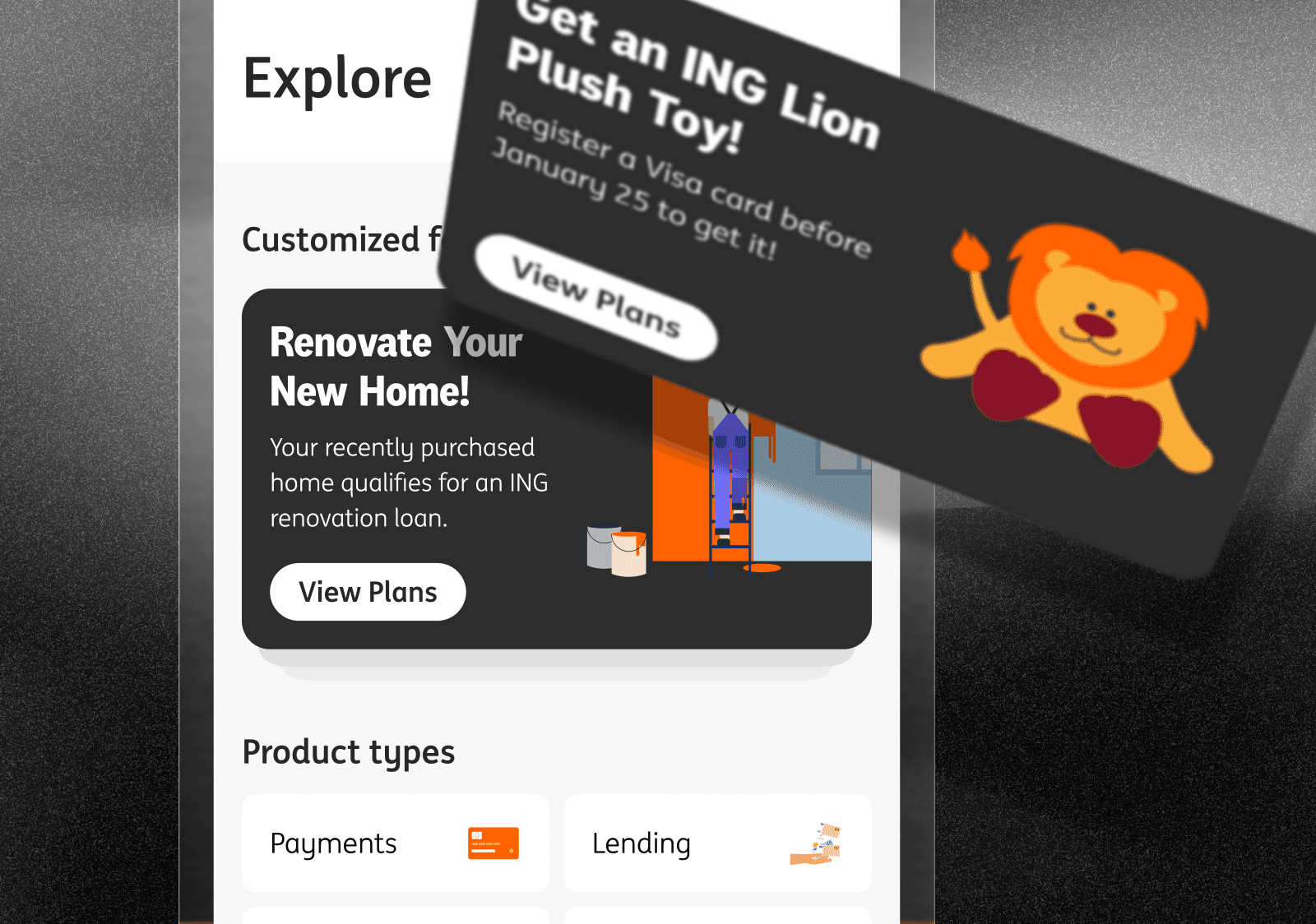
In the past, users often got lost in complex and cluttered product lists. The Card Pile borrows the physical metaphor of drawing cards in the real world. Users can quickly browse AI-generated financial products by swiping. The recommendation algorithm learns from users’ past interactions to surface products that better align with their preferences and values.
User in Control
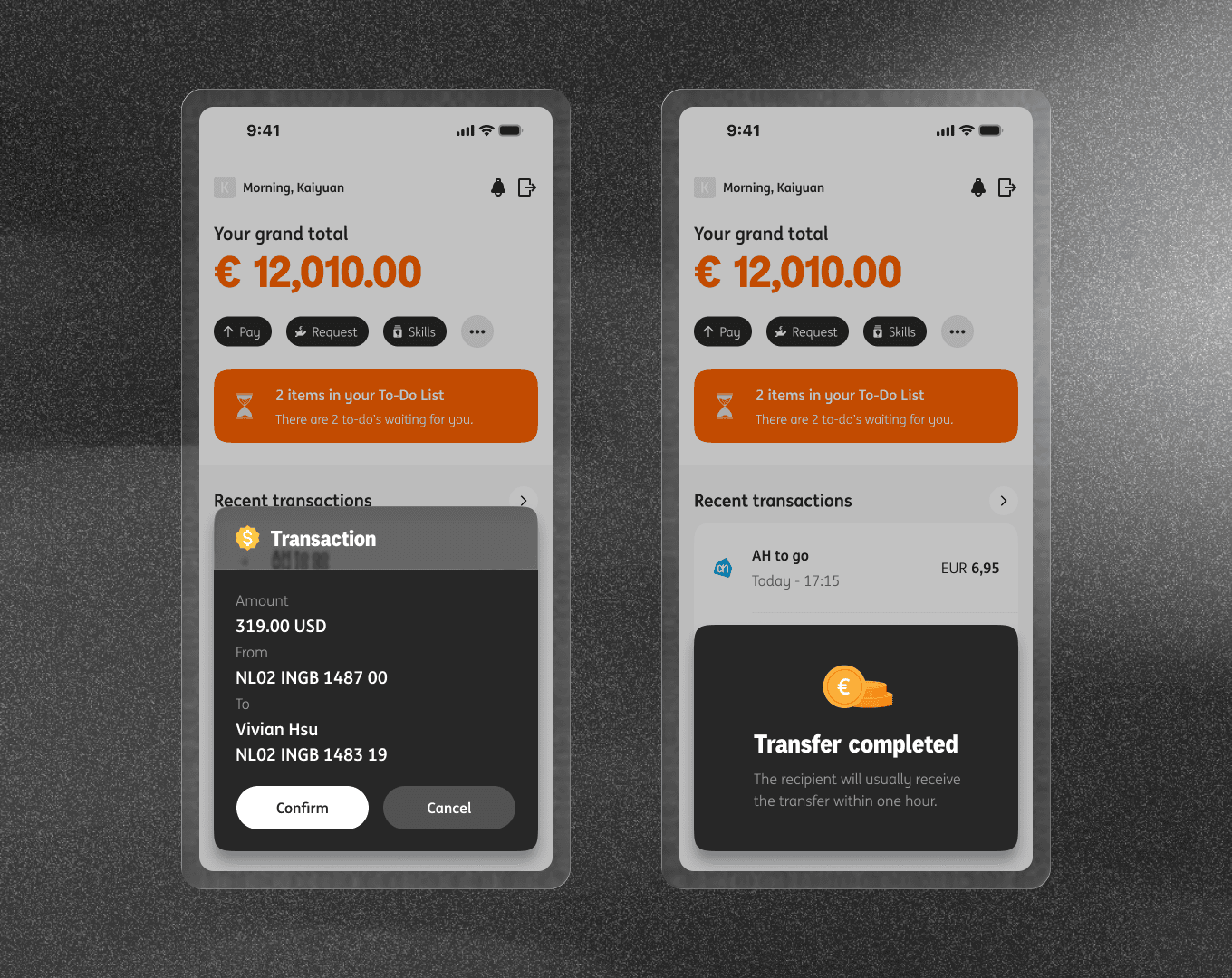
For LLMs, the accuracy of input determines the controllability of output. This is especially critical for financial products, where a single major error could result in significant losses and customer churn. I used a confirmation page and variables to improve input accuracy and ensure more reliable outputs.
For all high-risk tasks and operations that access sensitive information, users must provide confirmation to ensure that their true intent aligns with the action.
Human Confirmation
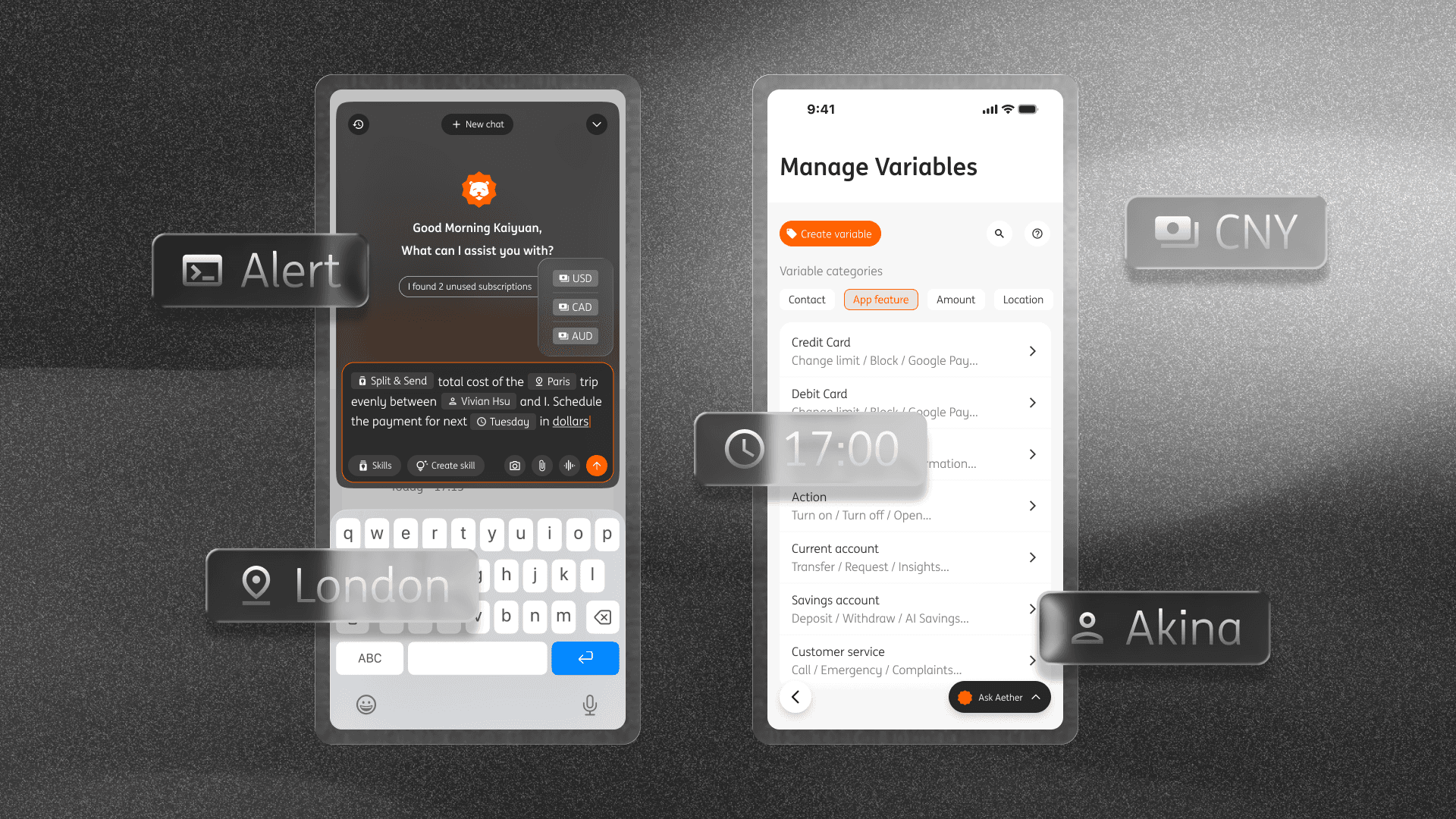
I introduced the concept of variables to address input uncertainty. Variables represent specific objects involved in a conversation, such as contact information, app features, amounts, or locations. User inputs are interpreted as combinations of these variables and executed in a structured manner, reducing hallucinations, ambiguity, and errors caused by typos.
Variables
Optimized Efficiency
ING serves not only retail banking users who handle multiple tasks daily, but also business banking users who manage multiple accounts and process hundreds of tasks each day. To reduce the time users spend typing and waiting for tasks to complete, I designed multiple input methods, introduced the concept of Skills, and created a multi-task interface to improve efficiency.
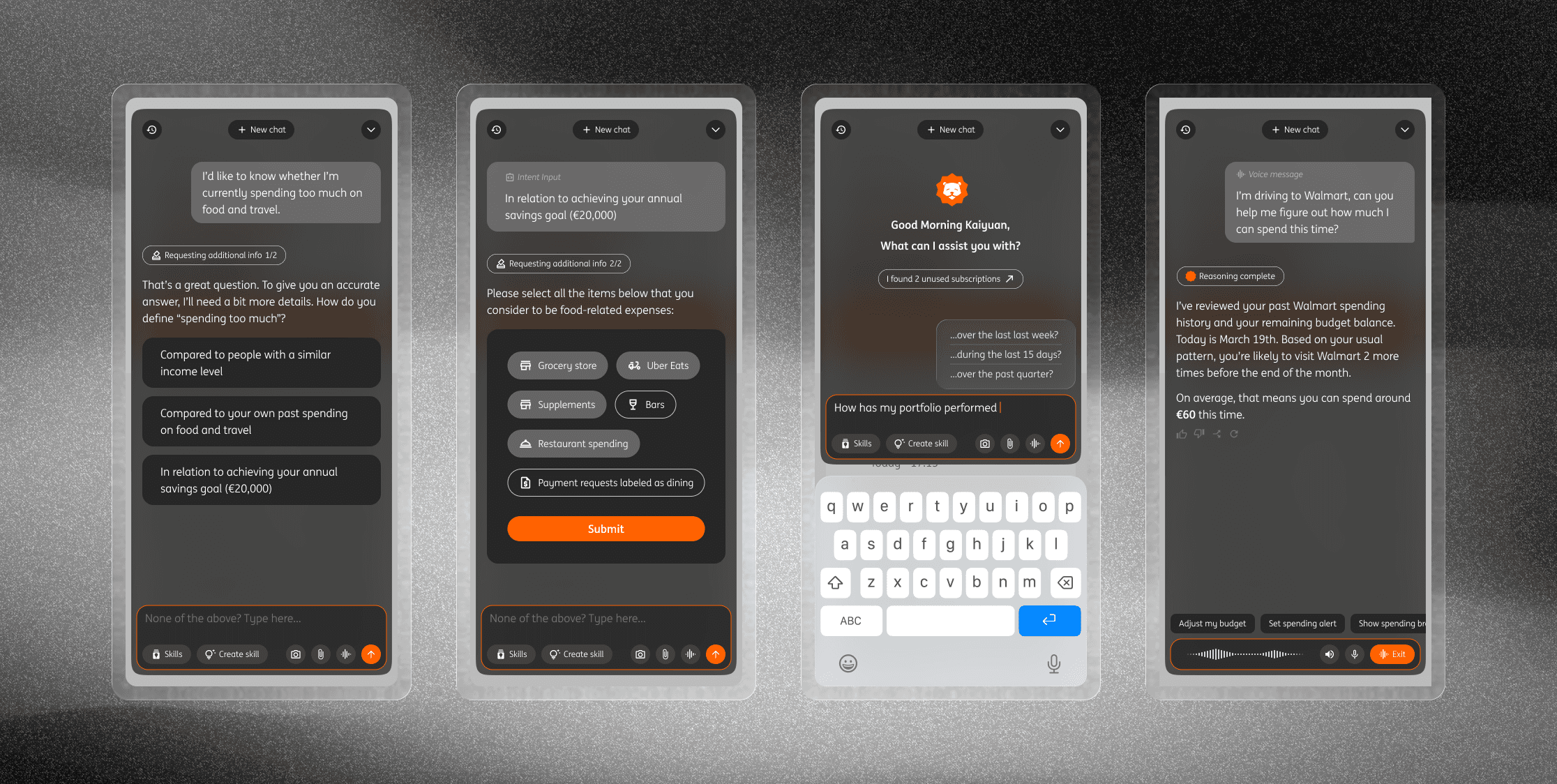
In addition to common multimodal inputs such as voice, images, and files, I designed an input prediction feature. For complex tasks, Aether generates input UI components that allow users to enter information quickly by selecting from suggested options.
Enhanced Input Experience
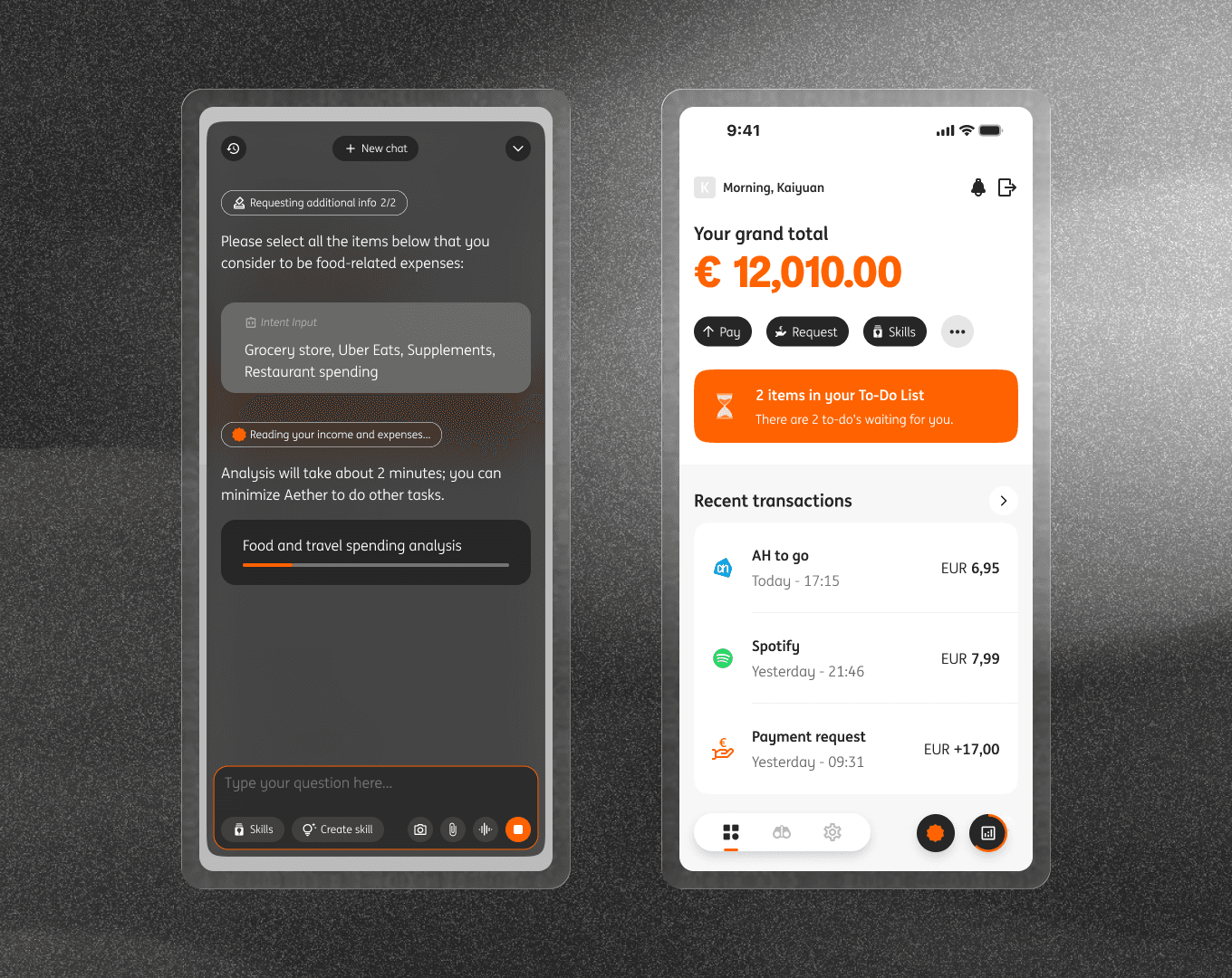
Users can minimize ongoing tasks to the navigation and switch to other tasks.
Multi-Tasking
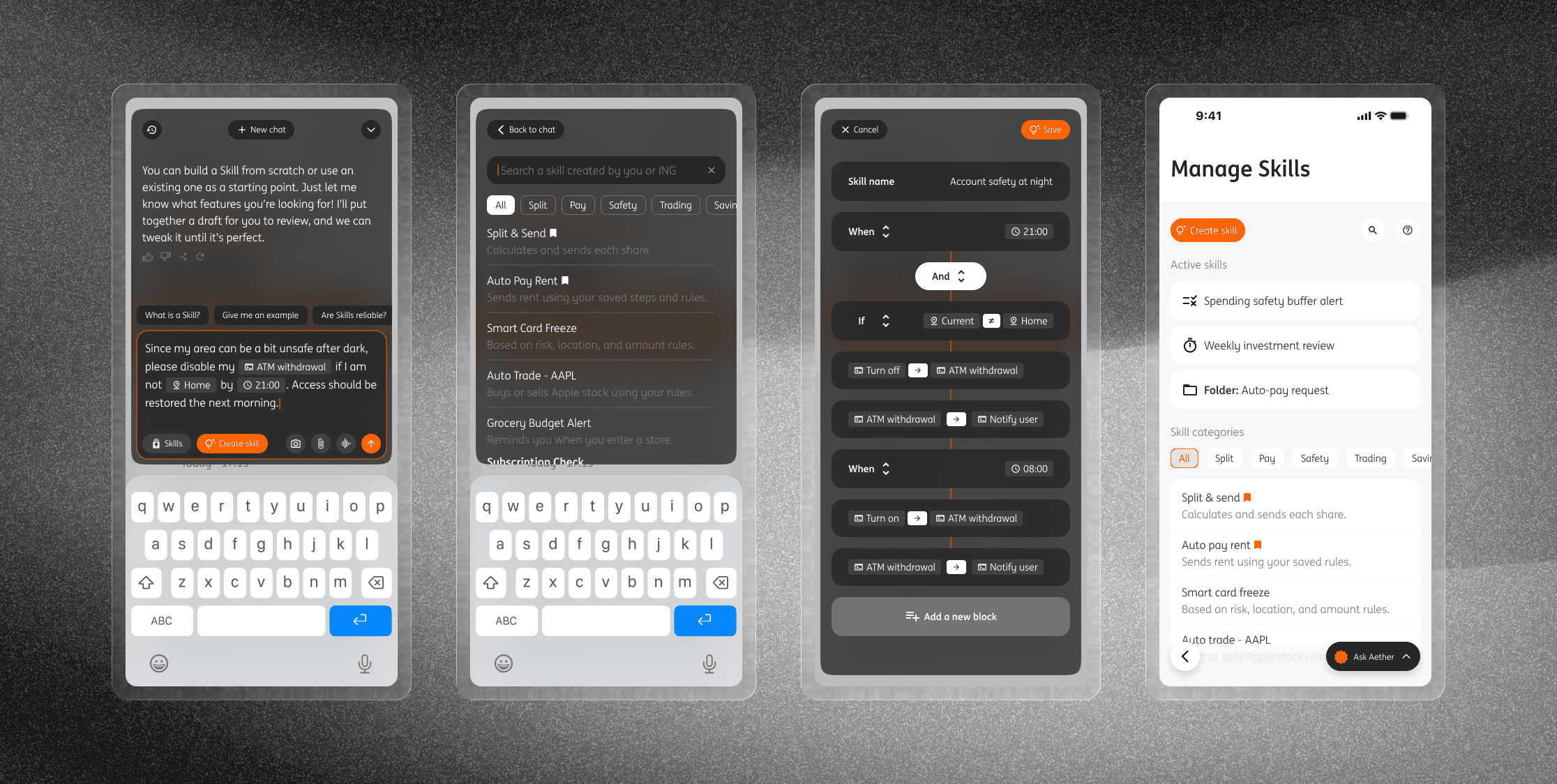
Skills are the core concept of Aether. Users can create a Skill by combining a series of Variable-based actions into a reusable workflow. When the same task needs to be performed again, the user can simply invoke the Skill instead of repeating the steps manually.
Skills can be nested. One Skill can be part of another, and an existing Skill can be duplicated and modified by adjusting certain variables. Skills can also be triggered by time or events, enabling automated account operations.
Skills
Hyper-personalization
ING is one of the largest banks in Europe, serving users across nearly all age groups, income levels, and political backgrounds. Different users have different levels of acceptance toward AI. In addition, users vary in their goals and frequency of using the ING app. A single design cannot meet everyone’s needs, but with AI, users can define how they use the ING Aether app.
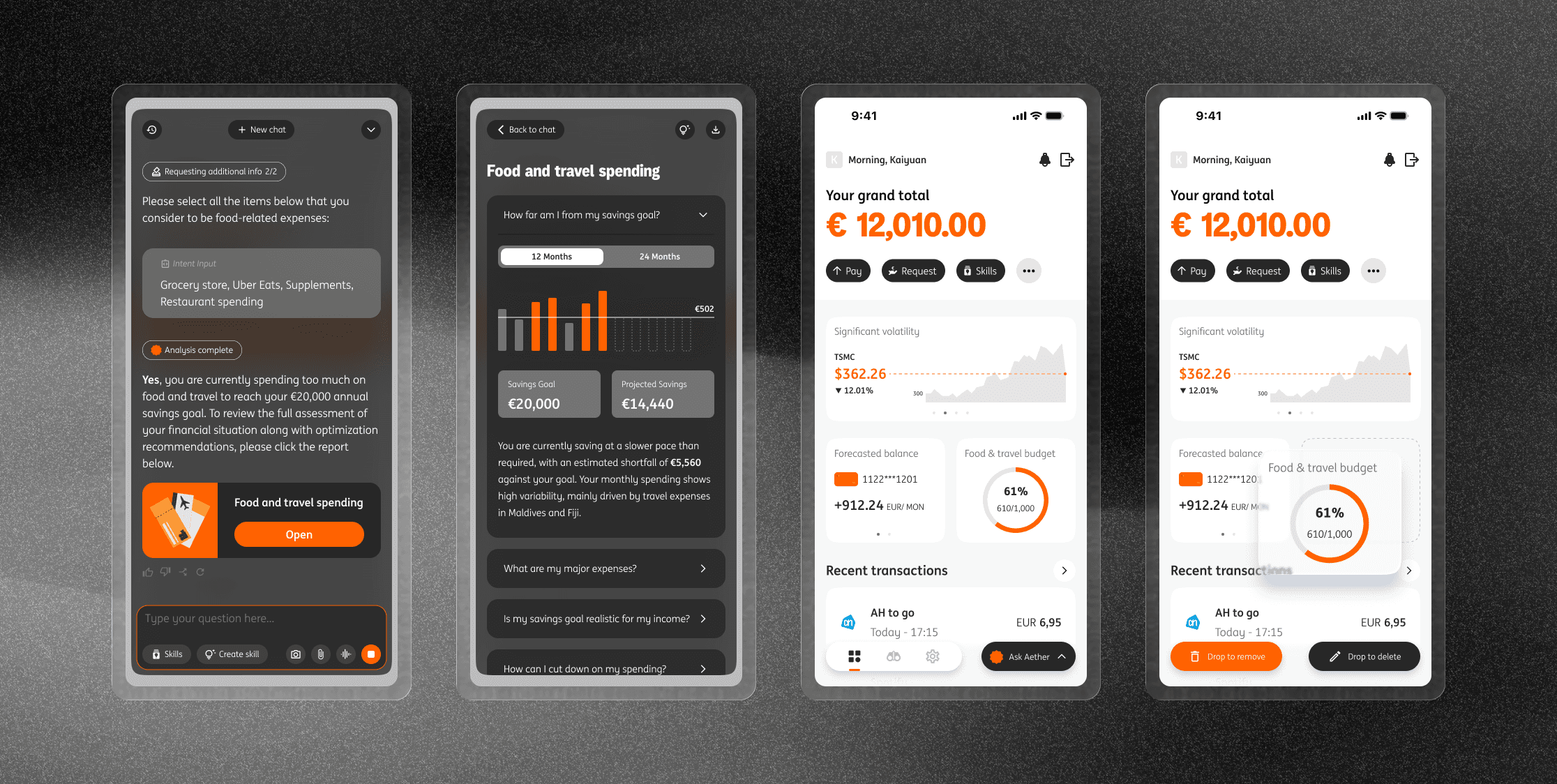
To enable homepage personalization, I designed a series of interactive and stackable widgets. Users can also save Skills as widgets.
Widget
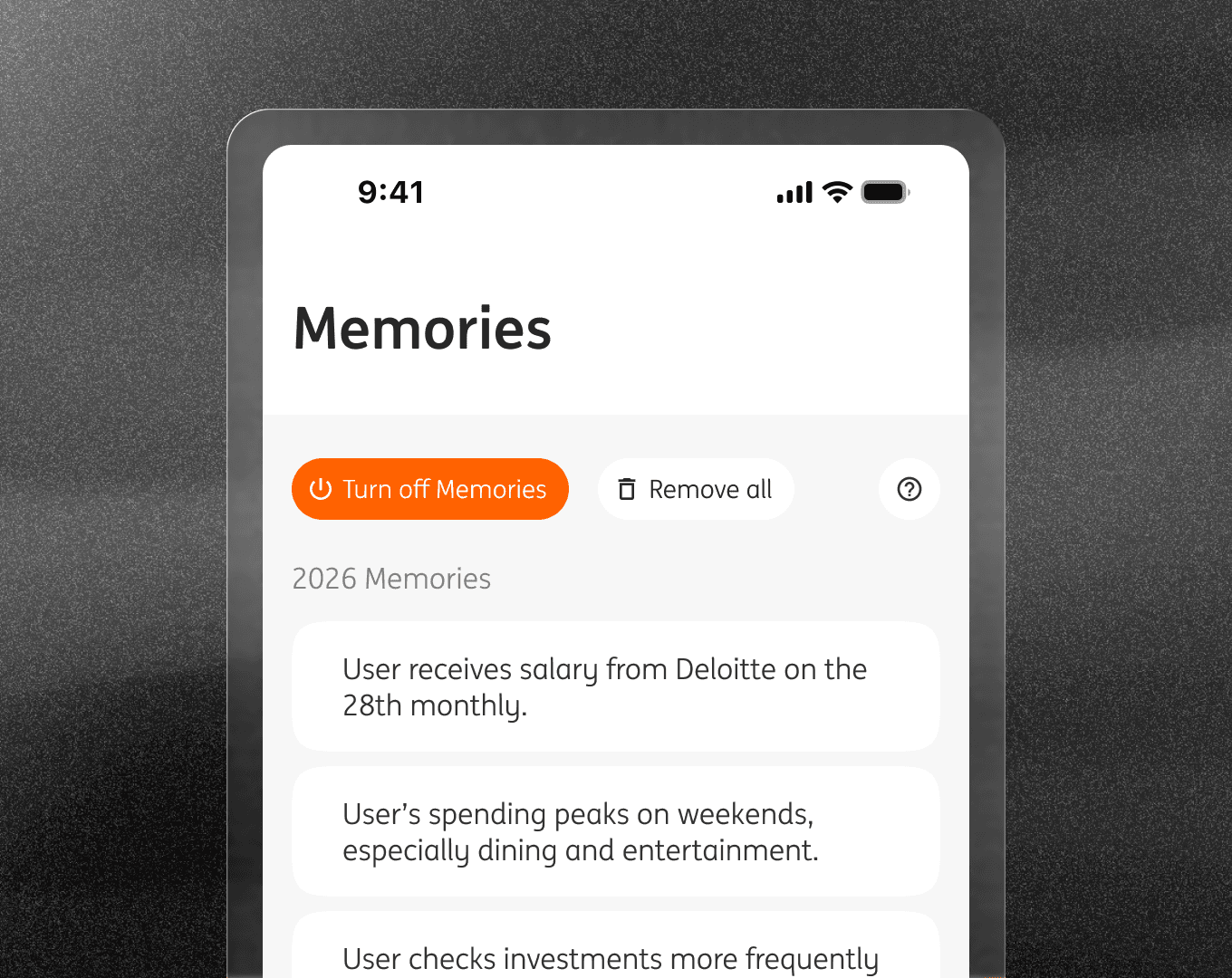
Memories are collections of user preferences stored to provide more personalized and consistent responses. Users can choose to clear or disable Memories to protect their data privacy.
Memories
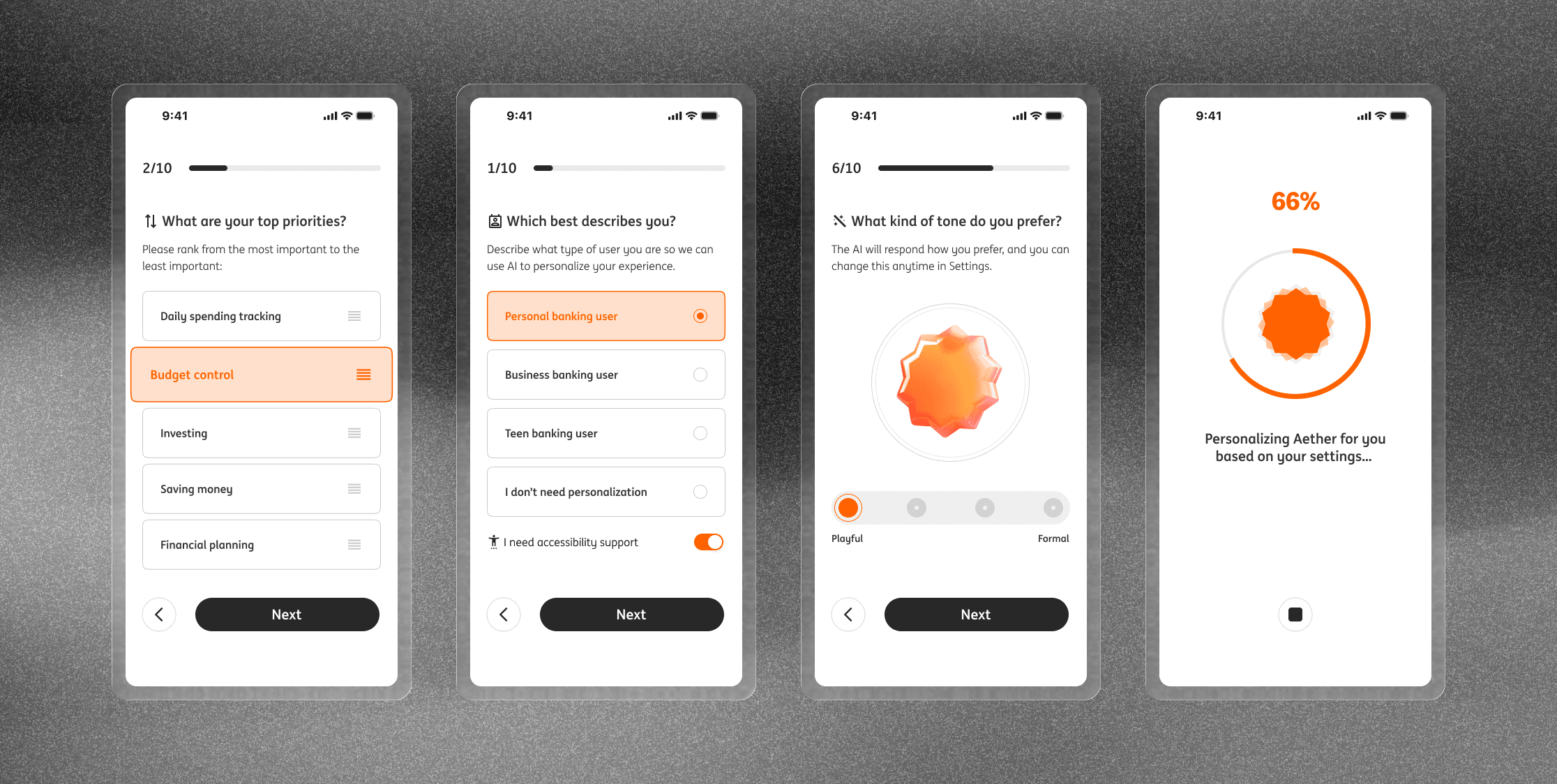
During a user’s first experience with ING Aether, they go through a short questionnaire. AI uses their answers to personalize the home screen and tailor Aether’s responses.
Onboarding